Central War Gaming events lean hard into "light infantry" methods, for several reasons. "Light" is a reference to the weight and bulk of the total lifting and logistics tail required to move and support a unit. An APC is a lot heavier than the troops inside, and need ammunition, fuel, parts and repair centers; but the end result is the old joke that individual light infantry soldiers carry the heaviest packs.
We also allow for a "ready bag," and it has been very helpful for many of us, but seems to still be a point of confusion for many participants. For many units at Swift Fox 23 this will be even more important than usual.
There is going to be a supply point, for each faction. It may be at your basecamp, or near (but not quite colocated with) the aid station, or it may be somewhere else entirely.
It will be a pallet with your resupply ammunition, at least one 5 gallon water jug and maybe other things.
It will also have room for you to put your ready bag. Another bag, or box, with extra stuff.
The backpack/ruck/bergen is required for the Arden and Kitoy — and strongly suggested for the GDL. In it you should carry everything you know you will need for sure in it, and some specific required things like water, first aid, rain gear, a sleep system and shelter, food and so forth to survive.
But you don't have to carry literally everything you might need. Say, the spare uniform. If you think one is good enough, put the spare in the ready bag. If it seems nice, and dry, you can put some of your more extreme cold weather gear in the ready bag instead of the ruck. Then, if you fall in a creek and get wet, or the weather changes, you have to ask your CoC if you can hike over to the supply point and get your spare stuff.
Or, it's airsoft, so the guns are fragile. If you want to bring a spare, you don't ruck it around, but leave it in the ready bag. You can bring all sorts of stuff into the field, have it available, but not have to carry it with you.
(Remember, there's no going back to the car for something you forgot once the game starts. If you want it, put it on the ruck or in the ready bag).
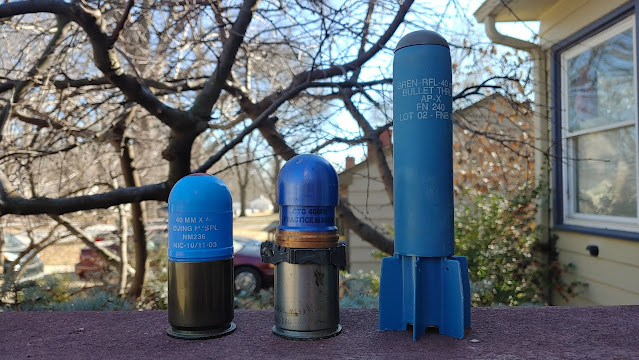
Also remember reloads. You can carry ammunition into the field, but cannot make more on your body. A 40 mm shell, or rocket, can be loaded into the launcher, but to recharge it with gas, and load a new projectile is something that can't happen.
We pretend you are going back to the supply point to get more ammunition, but you may instead use supplies you left there to to recharge them all.
(Yes, if your stuff leaks, you can bring spare gas into the field to top off. We're not monsters).
The supply point and your ready bag is often near the aid station because then it's close to you when you are dead and recovering. I also have some spare snacks, a water bottle, and anything else I might want for comfort in my ready bag for these rest cycles.
When killed, I can go rest in more comfort than I might otherwise. For example, in the aid station I'm static so a warmth layer just for this location is useful to not get cold. You may choose to even have a spare meal and the required heating and eating gear, so you can fully replenish yourself even if your ruck is far away, or just to avoid using the portable ones.
If any of this seems a little unrealistic, remember: it is a game. Not in the sense that it doesn't matter, but that it is compressed in time and space, and that other resources are imaginary. You can't attack enemy aid stations not for game rules alone, but because they are supposed to be actual aid stations, with medics, and guards with machine guns.
Likewise, the resupply point is not really just a pile of stuff, but there are logistics staff, and maybe even — depending on your scenario — vehicles moving in and out of there bringing you more supplies through the event. That's why you can have a rocket launcher with three reloads only, but go get three more reloads as many times as you want.
Technically the ready bag is not required. If you want to ruck in everything, go for it. And, we say "ready bag" but if you want to put your stuff in a giant Hardigg case (as I have) that's fine also. Don't overdo it, as we all have to move it in and out of the field, and maybe for you. A bag not bigger than an A-bag (though we suggest waterproof as it'll be unattended and outside) is good because if needed you can have someone else go get it and bring it back to base for you.
For the GDL, there's even more room to maneuver. You will have a basecamp so as far as we're concerne you can carry ONLY the ready bag of stuff, and use LBE or assault pack for what's needed in the field.
As always, talk to your chain of command and ask what else they require of you, and plan for other team gear you may have to carry before you decide what to pack, and how.
The rifle grenade is almost entirely missing from the mind of the American servicemember or weapons aficionado. That’s because of project SALVO, which went nowhere but did give us project NIBLICK which begat the 40x46 hi-lo 40mm cartridge and eventually the M79 (it took a while to get a useful launcher) around 1961.
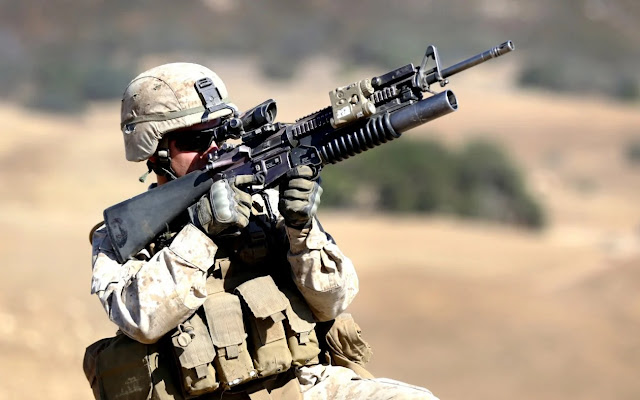
The 40 mm launcher has taken over the throw explosives over there role worldwide for some convenience, and a lot because of my usual argument for the prevalence of the M4/M16: the US became the only superpower. Plus things like consolidation destroying many entire national arms industries, the easy choice becomes “buy whatever mature system the Americans make.”
40 mm is fine, but the one bad thing it has caused is a lack of imagination. We think rifle grenade technology stopped being developed in 1954 so Korean War rifle grenades are what is being talked about. No one even considers what else is possible, far too often.
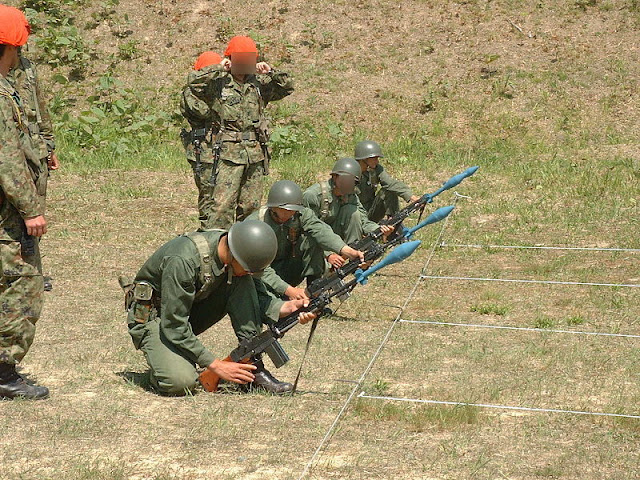
Japanese soldiers firing old school big steel ENERGA rifle grenades off their Howa Type 64 rifles in the late 1960s.That's over 50 years ago.
The Mythology of Rifle Grenades
A lot of people dismiss rifle grenades because of beliefs that are out of date or wrong. Let's look at those first:
Inconvenient — You have to carry blanks. Turn off the gas system, maybe change other things about your gun to fire
Needs a launcher — In fact, that you can't just shoot them off the muzzle then, but you also have to carry the grenade launcher adapter and first mount it on the end of the rifle first
Dangerous — If you use a live round instead of a blank, that will ignite the grenade and blow you or your squad up. This is not just a danger but a fear so troops ca be reluctant to use, or flinch more.
Ruins the rifle — If a bad guy pops up close you can’t shoot them with your rifle.
Recoil — Use it wrong and they knock you down or dislocate your shoulder.
Heavy — Rifle grenades are huge and heavy.
The MAS49/56, the french service rifle more or less from the post-war rebuilding until the FAMAS, had a standard 22 mm lug and a gas cutoff system integral with a grenade sight. The earlier MAS49 had a grenade launching adapter as well.
The Truth of Rifle Grenades
So one by one, let's discuss each of these points:
Inconvenient
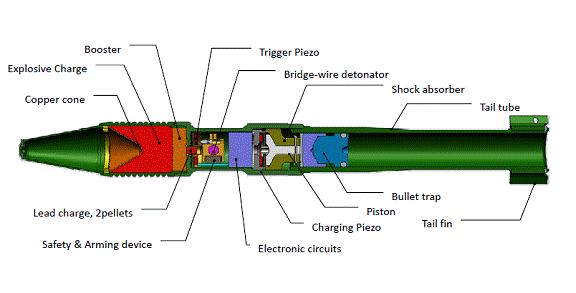
Nope, they don’t use blanks anymore. Most rifle grenades are what is call the Bullet Trap style. Exactly what is printed on the tin, there’s a trap, you fire live ammo and the gas AND bullet impact force are used to propel the grenade. Some — like the TELGREN and the JAPANESE WHAT??? are Bullet Thru, which also is entirely explained. Self- sealing hole down the middle, snags all the gasses and I presume a bit of bullet inertia also. Means you can’t accidentally use some AP round that might go through the trap but mostly lighter weight, as no trap. It does make the payload design hard, apparently, as you can imagine.
Needs a launcher
Nope. Not a thing. I mean, maybe for commies but let me introduce you to:
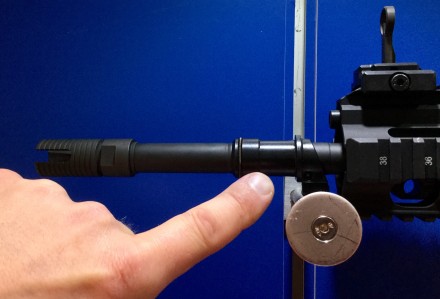
...the 22 mm muzzle device.
You ever noticed how all NATO rifles have the same diameter muzzle device? G3, M16, same basic outer shape. Why? Rifle grenade launching. Sure, dedicated orgs like the French have additional stabilizers back on the barrel for /better/ grenade launching, but all normal rifles, with normal muzzle devices, can launch normal rifle grenades for like 50 years. Grenade launching adapters are not a thing.
The spring is like a gasket or detent, which the grenade snaps on to so it has force to overcome to launch and doesn't fall off, but still can be removed by hand if not fired.
Dangerous
No such thing as explained above. So blanks needed so normal ammo will do fine. Safety has increased for ordnance generally so if somehow you shoot an API round it still should not ignite the grenade primary charge.
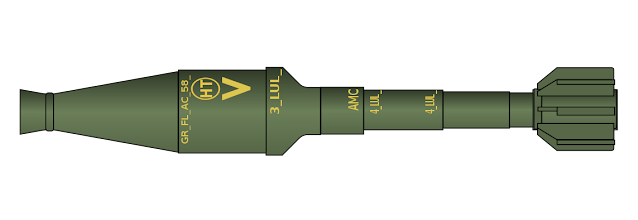
The current French issue AP-58, a bullet trap rifle grenade
An early bullet trap, before and after firing, from a Mecar rifle grenade.
Ruins the rifle
Besides being old (no adapters, no gas system shut off anymore) this is an armchair commando comment because in wars what do you bring: All you friends with their guns. See this guy walking around with a rifle grenade mounted? Because he’s got friends with rifles without grenades mounted.
Some KNLA forces in Myanmar maneuvering in a city, one with a rifle grenade on his M16 for an extended period of time.
Also, how’s an M79, M320, or even just the weird grip of an M203 give you the instant ability to shoot someone with a rifle? Even if you notice (aiming at someone far away, etc) my favorite solution in the very unlikely case this comes up: shoot em with a grenade!
Recoil
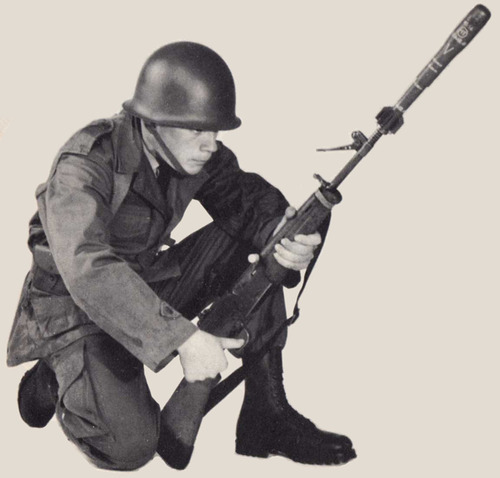
Again very old information and also sort of irrelevant. If you are a WW2 soldier with a big adapter and heavy steel rifle grenade you also had what they call Training. You know this essentially turns your rifle into a mortar so you place the butt on the ground. 50s-60s soldier? You are told to let it free recoil. Hold it at the waist and not let the butt touch anything.
A re-enactor unloads the ball ammo from an StG-58 and rapidly fires two training anti-tank rifle grenades at a tank target. Between the mortar-style butt on ground and modern shoulder methods were many of these free recoil methods.
And in both these cases, hard to forget as the grenade sights don’t work if you try to shoulder it anyway! But today, no danger. Mostly because the grenades are amazingly light. Some lighter than an M203 round. You know recoil is mass+speed so light rounds going not that fast is not that much recoil. The plastic construction also is like plastic stocks vs wood on a shotgun; they flex and soak up recoil. Yes, that works. The heavy payload end being squashily attached to the gun spreads out the recoil impulse to the gun, then, to your shoulder.
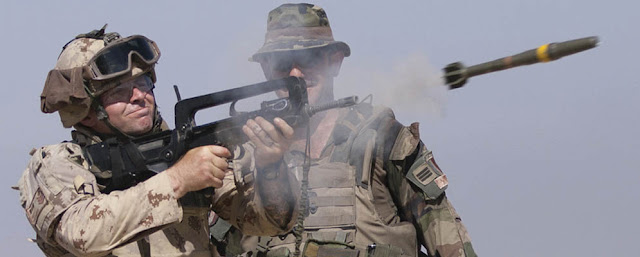
A Marine tries launching a rifle grendade off a FAMAS. This is someone unexperienced, at full recoil. He's just fine.
Some appear to have elastomeric attachments and the TELGREN telescropes. You extend it to fire, but on firing it collapses back down, which is super duper spreading out the recoil impulse over time.
Weight
Again, old data, like saying all American guns are heavy compared to modern Chinese guns and using a BAR as an example. Exactly the same. Modern rifle grenades are crazy lighweight, and as compact as they can be so easy to carry.
Things Rifle Grenades Excel At
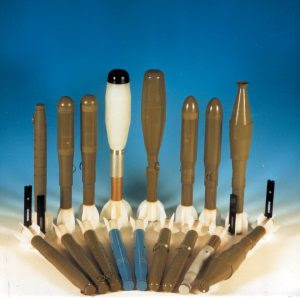
Mostly, being spigot launchers. Fundamentally, that’s the most important one to me. You are’t restricted to things that fit into a barrel, the requirement the outside of the projectile be able to handle in-a-barrel forces, or carry around a cartridge case or otherwise propellant to launch that.
The full range of rifle grenades from one maker. Note how they are all different sizes. The size needed for their capabilities.
So, rifle grenades are available in different formats, like HE or AT. Flares and smoke. BIG flares; need some illum? You can parachute flare rifle grenades with similar properties to 60 mm parachute illum.
You can do really weird things. I can’t find one this moment, but “Ambush Breakers” used to be issued to a few armies. A rifle grenade, but it doesn’t launch. Instead it fires a claymore-like wide-dispersion shotgun blast off the end of your rifle! No special weapon system, just second in line in your jungle patrol has this mounted and is part of the immediate action drill.
A favorite of mine I SIMON, adopted with minor safety changes by the Army as the M100 GREM. It fires a moderately low-explosive charge at standoff, so you can knock down doors entirely, and with a reduced chance of destroying the whole room (and all occupants) beyond. Wide, long, odd shaped. Don’t need to make a new giant launcher for it as it’s a rifle grenade. Just stuff on the end of your M4.
The French and Japanese (two who issue rifle grenades to their entire armies) both use HEDP rounds. They blow up and can destroy equipment and kill troops in the open, but also have a shaped charge that is large enough in diameter they can defeat armor of anything short of a fairly modern tank.
A 40 mm can't do that no matter how hard it tries. HEAT warhead penetration is a function of diameter and 40 mm simply isn't big enough around.
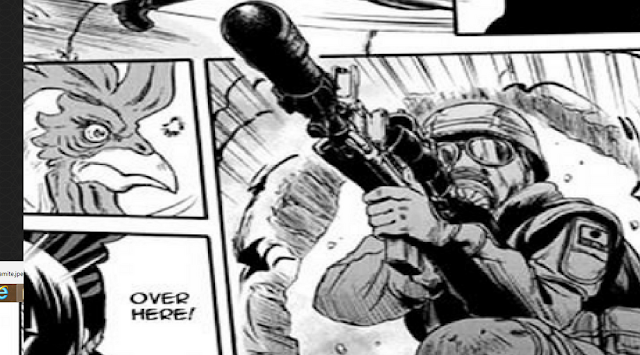
Cultural norms vary even to things like understanding rifle grenades. Japanese comics have Type 06s mounted pretty regularly, and otherwise rifle grenades are used in pop culture combat, not just 40 mm grenade guns.
Rifle Grenade or 40 mm?
A lot of this is about mindset. How does your army want to work. Like claims the MG42 is better than the 1919 or BAR are… asking the wrong question. They were each fine for the ways the armies worked, and switching guns would have been bad.
The US seems to like having grenadiers. IF we’re fine with 40 mm payloads, that works then because they carry what like 2 dozen grenades? But what if you don’t like grenadiers, and want most of your squad to have the ability to fire explosives to 300 m range? Then, rile grenades are a much better choice than a grenade gun.
Similarly, rate of fire is often brought into the conversation, for the relatively fast reload speed of M203/320, and the immediate firepower of the Milkor MGL (M32A1-MSGL in US service, finally), but of course it's the same conversation. If only one person is firing grenades, then their firing speed matters; if the whole squad is firing, then you can either mass fires or have everyone fire serially with discussions of wind and range, to adjust fire for each follow-on shot in the same way.
Weight alone, you can carry 10-11 Telgren (for example) for the same weight as 10 M203 and an M203PI. Over that load, the M203 gets the benefit. Under it, the rifle grenade.
Then it’s how you approach it. If you like having a grenadier designated, then a standalone 230 or Milcor with 36 rounds on him is likely a good idea. If you want everyone to be able to lay explosives, then everyone with 1-3 rifle grenades is good… OR, mix and match. Which is what we’ve lost with so so very much emphasis on the 40 mm. Why not have both, so you can carry not just breach grenades, but redefine what “organic” fire support means and bring bigger boom, smoke, or illum to the platoon or squad level.
Future Concerns — Suppressors:
Since I like to think systems, one issue that is going to be arising is suppressors. French love rifle grenades but I have also see whole platoons issued with small suppressors.
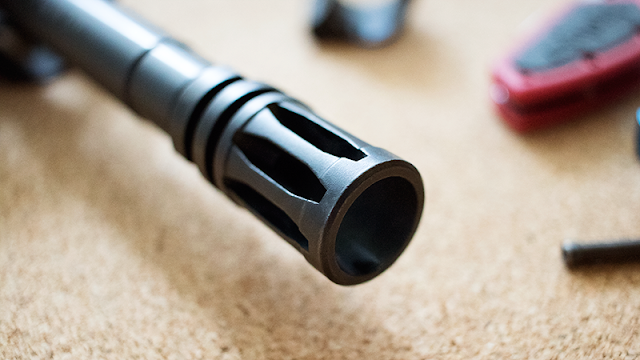
They may bring us back to all grenade guns or maybe… adapter like issues? You can’t shoot rifle grenades from suppressors or brakes. This seems solvable though, for example just put a 22 mm flash hider on the end maybe? But, worth keeping in mind if planning on equipping your army with rifle grenades as you may also want some to be suppressed.
Polyvalents:
An idea that was actually fielded for a while in the 70s was the polyvalent grenade. That is just a big word that means it's configurable and multi-mode.
See?! You can carry a hand grenade, and add a tailcone to it, now it's a rifle grenade. There are a number of other multi-configuration grenades around, like those with removable fragment sleeves, and now there are a few that are stackable to change how much they go boom or even become Bangalore torpedoes. So... it makes me wonder if things like this may come back some day.
A similar French one spanned the introduction of the bullet trap and became suddenly 2" longer with a big, obvious steel trap screwed between the tail and grenade. While it was a bit clunky, it also points to another value both rifle grenades in general can have, and polyvalents specifically: they can be any shape so things like this can be done.
Other Photos:
Too much to choose from for the article above, so I tossed more of them down here.
The formerly French issue APAV-40, with the shape charge and bullet trap visible in the cutaway
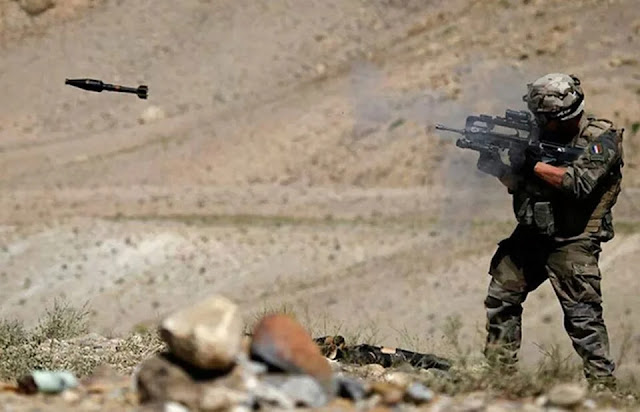
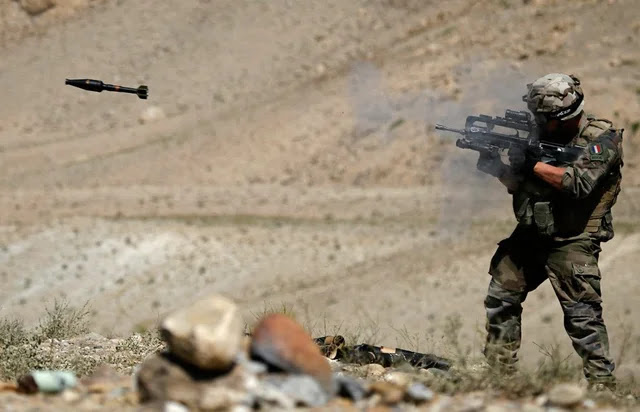
A French soldier from the 1st Regiment Marines Infantry (RIMA) fires an anti-tank grenade from an assault rifle FAMAS during a training session at the Forward Operating Base Tora in Surobi district
The three factions each have their own requirements, but the first principle is that they are uniforms, and allow identification so you avoid fratricide.
The rules we have are specifically to avoid even accidentally thinking the enemy is a friendly — or vice versa — sometimes based on experience. While mistakes happen and you are under no obligation to tell your opponents who don't shoot at you that they really should be, deliberately looking like the enemy is not an allowed tactic, and is grounds for dismissal.
Ardea
We've started to clarify what uniforms the armies prefer, vs allow. For Ardea the "gold standard" is French CE. That's their current-issue Woodland-like pattern and many clothing items are made, both surplus French issue and commercially. Nice modern stuff.
As an alternative, you can wear anything visually similar or easily confused for CE, including US M81 Woodland, Russian LES, or various commercial clones. That gives you a chance to have dirt cheap USGI surplus, and any of the resurgent cool Woodland stuff available now commercially, or for Marine Raiders, etc.
We also still permit British Woodland Pattern DPM, or any very close copies of it. If not sure of any pattern, ask us but very different shapes in similar colors (like Multicam Tropic) are not permitted.
Left is USGI "M81" Woodland, right by contrast is UK DPM on top, but with Woodland pants and hat, and a commercial Woodland-ish pack cover. but at a glance, they give the impression of a uniform appearance.
That's it! As far as strict rules, nothing else. But do remember to not ruin your uniform impression or you may be perceived as cheating, or become fodder for fratricide. For example, if you want to wear a plate carrier, and it's Multicam... that's probably a bad idea. It may even escalate to prohibited because you are covering too much of your body with the color of the enemy.
Different members of that same team in a different situation. The far troop is wearing French CE, but you have to know to look for the difference. Note how there's a coyote brown ruck and OD green LBE. Doesn't matter as the overall impression is Woodland. The pack is, when carried, covered with a CE pack cover to make double sure they are hidden, though.
If not sure, try it all on, get a photo, and ask your chain of command, or just us directly. We'll advise if it is fine, you can get away with it with caveats (e.g. for the plate carrier: only if you keep the LBE on over the top), or is simply No Go. We do this a lot, and often it's easy to shift the impression with some tape, spray paint, or changing a pouch or two only.
GDL
The basic summary of what you can wear as a GDL insurgent is: almost anything you want. You can show up in a clown hat, polka dotted shirt and red pants for all we care. Your chain of command may tell you to go change and certainly no one will want to be anywhere near you but it's not illegal.
You can't however wear a red jumpsuit, because suitability and sanity aside, there are really only two rules:
No matching tops and bottoms.
One piece must be a solid color, non-patterned.
The solid color cannot be OD Green as the Kitoy permits that as a uniform color. All these rules, and if you played GDL before, the changes, are from experience. We don't want you to be un-camouflaged, but when clearly visible we also don't want you to be confused with other forces in a way that seems unfair.
This should still give huge leeway as there are many very good camouflage patterns and colors not issued to the Areans and Kitoy, which this gives you a chance to wear. A common solution is something strange you like on top (tiger stripe, MARPAT, Flectarn...), and solid range or work pants on the bottom.
That means two piece uniforms are also required, though we're pretty loose on what "two piece" means. A camoflaged poncho like a zeltbahn is fine, as long as the pants are different. All in all this is designed to allow you to buy few or no pieces of clothing.
Some typical mismatched example insurgents, but no green pants now sorry.
Grab your favorite outdoorsy clothing, camouflages or not and wear that. I could wear my gray Vertx "jeans," the cheap Italian Vegetato combat shirt, and probably get away with an OD green plate carrier. Non-matching, pretty clearly not Kitoy or Ardean, and I am comfortable with modern technical gear.
These three on the right, part of a Ukrainian civil defense force getting refresher training, are good examples.
Hats? We don't care about hats. Hats are most identifiable by shape. By the second CWG event we realized there was so much helmet use that attempting to differentiate by shape (one side used to be patrol caps, one boonies) was pointless.
I'd wear better shoes, but activewear bottoms, military issue jacket, camouflaged LBE, muted color keffiyeh / shemagh
Camouflage pattern on hats and helmets is not terribly important so for the GDL: wear what you want on your head, or nothing at all. You don't even have to be consistent, and can have your favorite comfortably worn tan baseball hat with the Surefire logo, but switch to a USGI boonie for sun or rain.
Kitoy
Kitoy also has clarifications to preferred patterns, and their "gold standard" is Scorpion W2, or yes OCP, since that's the US issue variant since about 2014 so there's tons of it around here.
As an alternative, Crye® MultiCam™ and related patterns or close copies such as US-issue OEFCP and Scorpion W1, UK-issue MTP, Australian-issue AMCU, Polish-issue Suez, and others with the same basic pattern and color scheme.
We also still permit OD Green or similar solid green colors, partly as we want to allow LFSG to wear their favorite stuff. Any muted greenish color darker than khaki is permitted.
Even in classic as-issued Multicam-everywhere, green or woodland accents like the scrap of camouflage netting on the helmet, is entirely permitted as it doesn't change the overall impression of the uniform.
We're not picky about what we mean by "OD Green" so any muted greenish color darker than khaki is permitted.
Three different OD greens (uniform, boonie, LBE) and it looks fine. Everyone would say he's wearing OD green.
Same as for the Ardeans — but assuming you didn't read that if going Kitoy — That's it! As far as strict rules, nothing else. But do remember to not ruin your uniform impression or you may be perceived as cheating, or become fodder for fratricide. For example, if you want to wear a ballistic vest, and it's an old Woodland IBA, that's probably a bad idea. It may even escalate to prohibited because you are covering too much of your body with the color of the enemy.
We don't generally care much about accessory equipment like assault packs. Here is khaki/CB and Pencott Greenzone, and... that's fine. The overall impression is still OD Green.
If not sure, try it all on, get a photo, and ask your chain of command, or just us directly. We'll advise if it is fine, you can get away with it with caveats (e.g. for the plate carrier: only if you keep the LBE on over the top), or is simply No Go. We do this a lot, and often it's easy to shift the impression with some tape, spray paint, or changing a pouch or two only.
From the CWG point of view, we added Multicam a few years ago because hardly anyone incidentally had an OD green uniform, but nearly everyone now has some Multicam; at least some people have showed up with their work uniforms and equipment, just switched to airsoft. From the Kitoy, in character, point of view the army is a third world army in a somewhat eternal transition period, so individual units may have a mix of both uniform types.
Since OD green is official Kitoy uniform, insignia, and brassards are still green, and LBE in green works well with Multicam uniforms as well.
We also have been deliberately loose on mixing these as long as there's a good faith effort to wear matching uniforms. But if you want to wear ODG but your only GoreTex is Multicam, that's permitted. But with the identifier for GDL being mismatch, be very careful if you do this. Think about stuff like MultiCam GoreTex overpants, for example
Dress for the Weather
Much of the plains around here, and especially north-east Oklahoma, is great for training because the weather should see a doctor and take some mood stabilizers. You might see 70's, sunny and humid during the day and freezing rain that very night. Literally.
Make sure whatever uniform you bring has all the components to allow you to be comfortable in all likely weather. Becoming a heat or cold casualty is one sure fire way to make sure you have no fun at all.
Here at CWG we love lightsticks. Glow sticks, Cyalumes, whatever you call them, they are just neat, but we also use them a lot because we just do training and landowners, residents, and local fire protection districts don't like it when you set the training ranges on fire.
If you come to a CWG event like Swift Fox, you'll be loaned or given some stuff, like little bags of mini lightsticks for marking trails and campsites, and a few Cyalume flare-replacements.
"Minis?" "Flares?" Read on for more about all the various glowing products there are.
Sizes, Types, Runtimes, etc.
There are lots of versions and variants of many products, and while I am sure Cyalume has a neat Powerpoint explaining it all, they sure won't share with us.
So, just the "lightstick" products (they make some other chemical light up things) and with some cross-brand info:
Colors
Much like tritium, the phosphors have varying output. I don't have a solid list but my impression is, brightest to least:
Yellow
White
Green
Orange
Blue
Red
Pink
IR is only made by Cyalume itself AFAIK, and is hard to put on the brightness scale but seems plenty bright, similar to the yellow/green range, through night vision, but has no visible output so... not really a 1:1 comparison.
I think Cyalume doesn't make pink. it is often identified just by colored stickers which look like (or may be SOLD AS) red. It's not. They also look closer to purple to my eye, but it's called Pink.
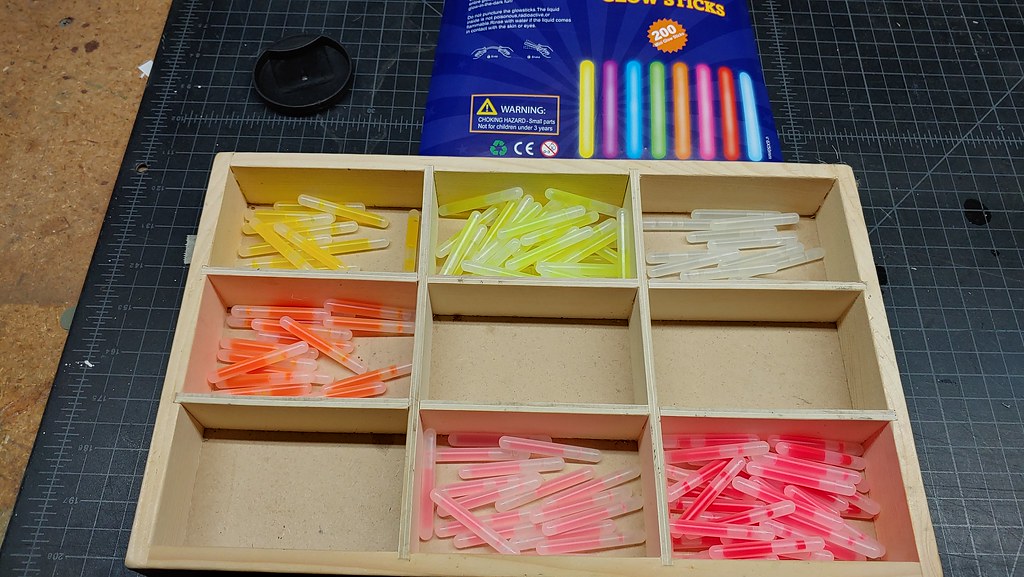
Colors when illuminated have no obvious relationship to colors when not snapped. If it matters what color a lightstick is, DO NOT take it out of the wrapper. There is no marking ON the stick and the color of a non-cracked stick has a very tenuous relationship to the glow color. The chemistry is what it is, so these colors for the knockoff minis shown are typical but... I wouldn't try to memorize, this is just for fun:
Left to right, lit colors: Yellow, Orange, Blue, Aqua, Lavender, Violet
Passive
Lit
Yellow
Yellow
Orange
Orange
Clear
Blue (IR also looks clear un-snapped)
Yellow-green
Aqua (but also can be... yellow-green!)
Pink
Lavender (did not come through in the camera, but I promise: lavender)
Red
Violet
I'll add more as I find additional colors like red.
Sizes
.09 x .79" (2.2 x 20 mm) - Sizes from here to .177" diameters are mostly used for fishing
.1 x 1'" (2.5 x 25 mm)
.118 x 1" (3 x 25 mm)
.138 x 1.18" (3.5 x 30 mm)
.157 x 1.5" (4 x 37 mm)
.177 x 1.5" (4.5 x 37 mm)
0.20 x 1.0" (5 x 25 mm) (.20 dia. is often specified as .197") - Cyalume USGI standard, IR and colors
0.20 x 1.5" - Alternative Cyalume and Lumistick size, no IR in this size
0.20 x 2" (5x50 mm)
0.25 x 1.5" f - Fatter, used in Marco dispensers and refills
0.25 x 2"
0.20 x 8" - Party or Bracelet or so on, other novelty assemblies or accessories may be in the box
4" — Never seen one, but NSN milspec Cyalume product in the same foil packaging as the 6", same shape of light, with the hook and all, seems the same diameter I think, just shorter.
also 4" – Don't have one now, not sure of diameter but close to 6" size, just shorter and straight cylinders with rounded ends. These are always low quality, often don't all light up, or light brightly. Usually have a thicker ring around one end with a loop but often not fitted so falls off, can't be used to hang it without glue or tape to retain the ring.
6" - The standard size, tapered, has become smoother over the decades but still faceted at the small end, transitioning to round, with a hook or loop at the smaller end and a round cap at 0.70" diameter. 8" is the overall length to the tip of the hook Mostly sold individually foil wrapped but bulk packs for special purposes are available. There are also 6" length ones that are shaped and built like the 4" ones.
0.70 x 8" — Flare Replacements — 8" overall, but a rounded-end cylinder of 0.70" diameter over the whole length. No hook. Taped-on wire feet. Can be removed but be careful and you then have to take it out of the wrapper so use it soon enough.
10" (not sure diameter) — Some in or integral with a plastic cylinder with flat ends. Sold for escape, and for marking of emergency scenes, evacuation sites like CCPs, etc. Also sold as a flare replacement like the 8" with two feet on the end as a bipod, also as the Self-Standing Baton, with an integral wire tripod to make it stand straight up about 4" off the ground.
12" (not sure diameter) — Heavy duty, but not clear what that means. Similar marketing to the 10" but not as well cataloged (i.e. "shop by length" doesn't have a 12" size on the Cyalume site though they sell them)
1 x 14" — No-name import that is broadly a 15" cyalume competitor. Seem to be reliable, beloved by divers for example, and seems to be reliable enough they tolerate them, at the $15 they are apiece.
0.70" x 15" — Same size and appx shape as flare replacement, just longer. Often as high or ultra-high intensity. Often as impact. Some individually wrapped, some in 5 pack cylinders. Impact come in a resealable bubble wrap bag in the tube when in bulk, when individually... be careful? Available in IR in 3 hour mode but while they may exist I have not seen longer timeframes available in any colors.
0.24 x 22" – Sorta just very long party/bracelet lights but IME the fatter size, won't fit into mini holders IME.
(Sizes are nominal guesses, actual measurements are a bit under or over on average IME)
Other products probably use existing sizes above but are not sold by sizes, and it's unclear what they are:
SOS Signal Light. Light in a cardboard tube, extend and it comes out on a short string. Pre-made buzzsaw in a box.
PML, Personal Marker Light, permanently mounted to a case with a big clip, for putting on life vests, etc. USCG Approved.
PML Dual Personal Marker Light, two of the above in a rigid V shape. I am sure like cateyes the shape/size helps tell how far away, azimuth changes, etc. USCG Approved.
Marker panels ... flat adhesive things in square and round
More! I will add more as I notice and have spare time, give tips on the tripflares, for example. Ask if you have questions...
Illumination Times
Time correlates to brightness. Apparently it's pretty close to correct to think that all of the same volume have the same energy, and the mfg can tune how fast it all releases.
5 minute "ultra high intensity" – This is practically a flare in all but the brightest condition. In moonless dark, is hard to look at
30 minute "high intensity" – Also very, very bright. Versions are sold with little wire holders to keep off the road at a 45° angle, as "Flare Replacements" by Cyalume themselves. These are often quite cheap, but BE CAREFUL of the wire bit. There's exposed wire ends, so don't throw them at others in training or you can put an eye out. The wire is removable, but the tape is fiber-embedded so you'll need a knife, don't cut yourself.
3 hour — Apparently only for IR output lights. Cyalume 1.5" minis are labeled as 3 hour output. No idea if this is because of a mil request for that output level or IR phosphors are weird so they had to do that for chemistry reasons.
4 hour — Cyalume rates their visible 1.5 minis at 4 hours
6 hour — Many Cyalumes, but also my guess as to what would be the official rating for many third party 2" minis, and party sticks. They talk about a range of times, but including the tail end brightness, this seems right
8 hour — Sorta the "standard" lightstick but mil issue ones also in 6 and 12, with no obvious reason why. IR is only apparently available in 3 and 8 hour.
12 hour
24 hour — I have never seen one, but reportedly true
Activation
Crack. Manually break and shake or (more effectively) break across the entire length. Even minis will get more output from breaking the entire length. Break multiple places, or run your fingers along the length, cracking as you go.
Impact. Almost entirely only available in the 15" sizes, throw or drop from a height onto hard surfaces and they activate themselves.
These are pretty common for trail marking and so on, but there's a bit to know about them. First, unlike knockoff full size ones, some are different diameters. Here the bottom one is from an $11 tube of 200 no-name, color assorted ones. Visibly fatter.
Top to botton: Cyalume, Lumistick, No-Name.
Note that Lumistick has the characteristic pointy end on the minis and party-size (as shown to right of the mini). They are FOR SURE not rebranded Cyalume but clearly from a different factory as much as quality and packaging often appears to be identical.
The larger size is notably larger. Won't fit into things designed for the Cyalume-spec diameter like the helmet mounts I've mentioned we're (slowly!) prototyping but a few of you have, or I presume the MARCO but I don't have one.
There are even smaller sizes used for fishing lures in some manner I don't get as I am not a serious fishing person:
Since I had to sort a bunch of bulk purchased ones by color, then bagging and labeling, I had to look at them a lot and had them in color-separated bins so you can see the daylight and illuminated colors. Note they do not always correlate so don't trust the colors when not cracked to have any relationship to the glow color:
Tactical Markers
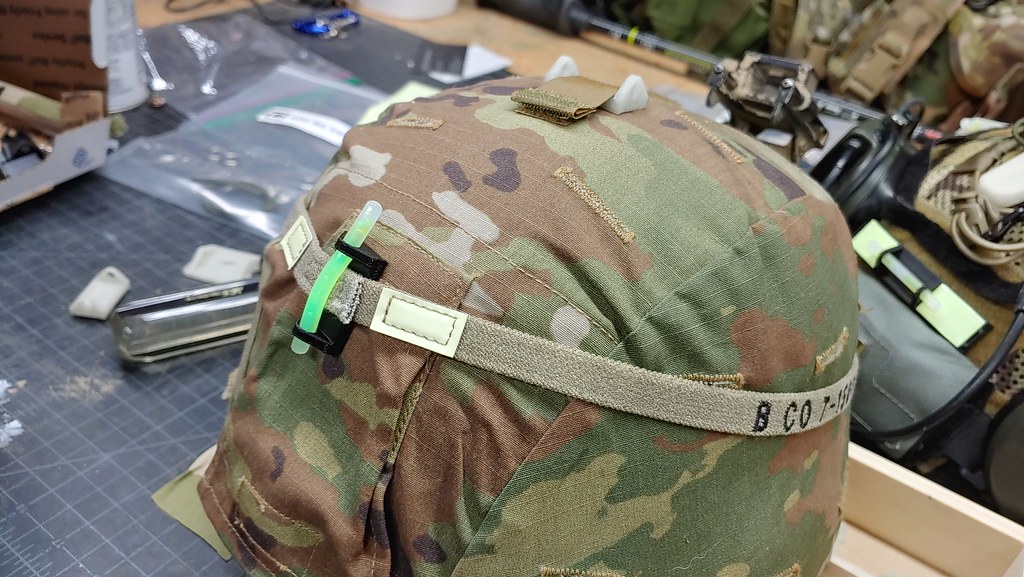
Mini glowsticks are very useful individual ID markers. I've had full size ones fussed with in the wrapper, and stuffed into webbing or helmet bands with varying degrees of success, and as I said they still generate far too much light. Minis work better stuck into bands, bungees, etc. and there are holders (all those shown are the 3D printed ones under development, absolutely NO ETC) to make them work better.
While these happen to be yellow/green, one good use is color. Aside from trying to color code your side to tell apart from other lights, you can code units. We've done that lately and it worked very well for a large movement; the scouts were blue, so everyone in the assault unit could find them, and could know to follow blue people.
Markers of any sort can be overkill. This (on the right) is brighter than the (left) cateyes, but is that necessary in the woods?
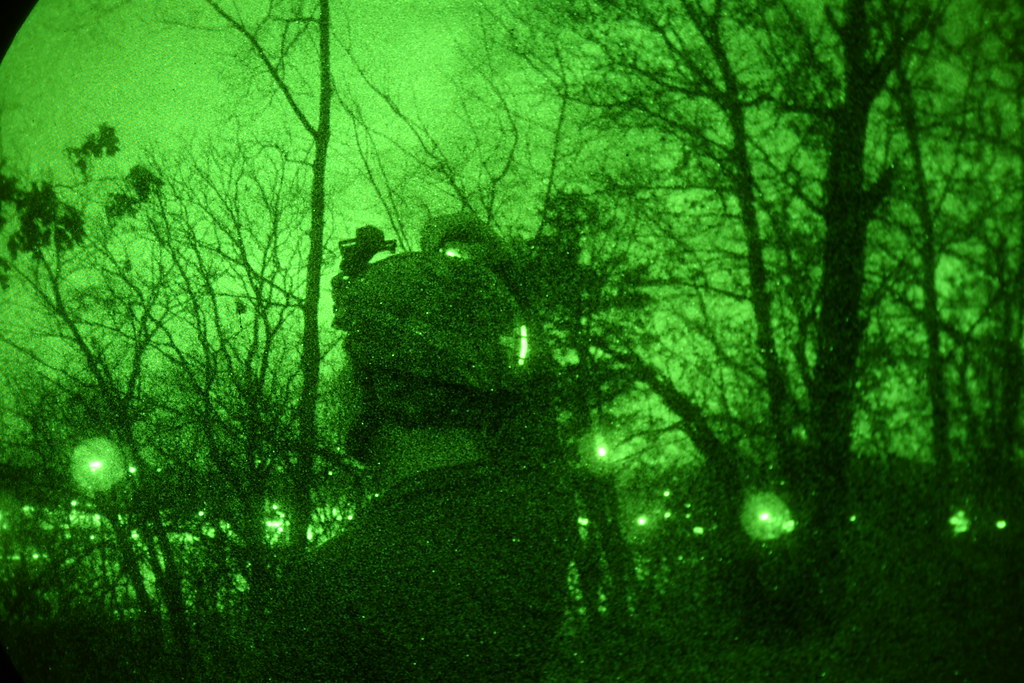
Often no, and it can even get troublesome, to glaring out NODs, harming night acclimation. But there are different environments. Built up areas have lots of light that can make cateyes disappear, so you can loose at least immediate orientation on your team. Distant lights as below can be even worse as the distant lights are so distributed and so many small points appearing and disappearing behind branches et al they are easily are confused with moving individuals closer in.
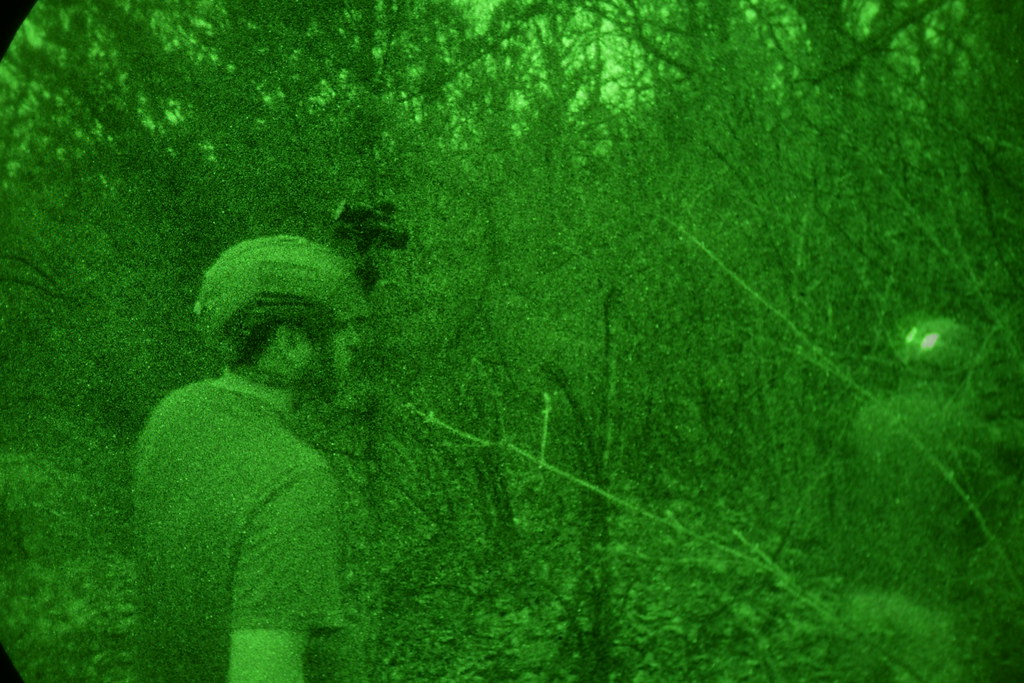
The glowstick here helps make your team-mate pop, and (when you look under the NODs, etc) color can again help with more positive ID:
I haven't done it much, but suspect the long "party" sticks might further be able to help if the light environment gets really confusing, as they can act like cateyes, provide not just more light but a shape, so it's easy to tell how far away, and what angle your team-mates are facing.
I have done this on the kid's bike helmet, both for more markers when biking at night, and to follow him around at night playground time and it seems to work. More to investigate there.
"Party" Lightsticks
One of my favorite tricks is the party or bracelet. As thin as minis, but longer so when used as a marker they indicate direction or shape. You can indicate direction on a trail, or when taped to a guyline. Minis are too small so read as point sources so it's hard to tell how far away they even are.
Full sized Cyalumes CAST light. They illuminate an area, so in camp can give away your position by lighting up the trees above, etc. Even when you cleverly arrange the wrapper, they emit too much light. Just use smaller glowsticks if you can get ahold of them:
Both the small diameter sizes put out so little light you can make a patrol base so bright from paths and trip hazard markers you worry you won't be able to get to sleep, yet they only work in line of sight, so 10 m away you can't see it at all, even on NODs.
Minis can become lost. Toss one in tall grass or even a normal forest floor, and they can disappear under the leaf litter. In a sandy area, become buried within minutes. The party sticks you can stick in the ground so they protrude up.
If there is anything bad about the 8" mini-diameter party sticks it is their fragility. You can't put them in the loops of your MOLLE vest as they break instantly. They also come in 100 packs so tend to be campsite or very deliberate use. And, lightsticks expire, so out of wrapper they have only a couple years left.
But, to go down even further to consumer mode, they sell 8 packs! Foil wrapper, cardboard case.
I have had 100% success with consumer brands when trying them. I assume like many products, there is no cheap lightstick factory, just Lumistick makes them under contract so they are +/- as good.
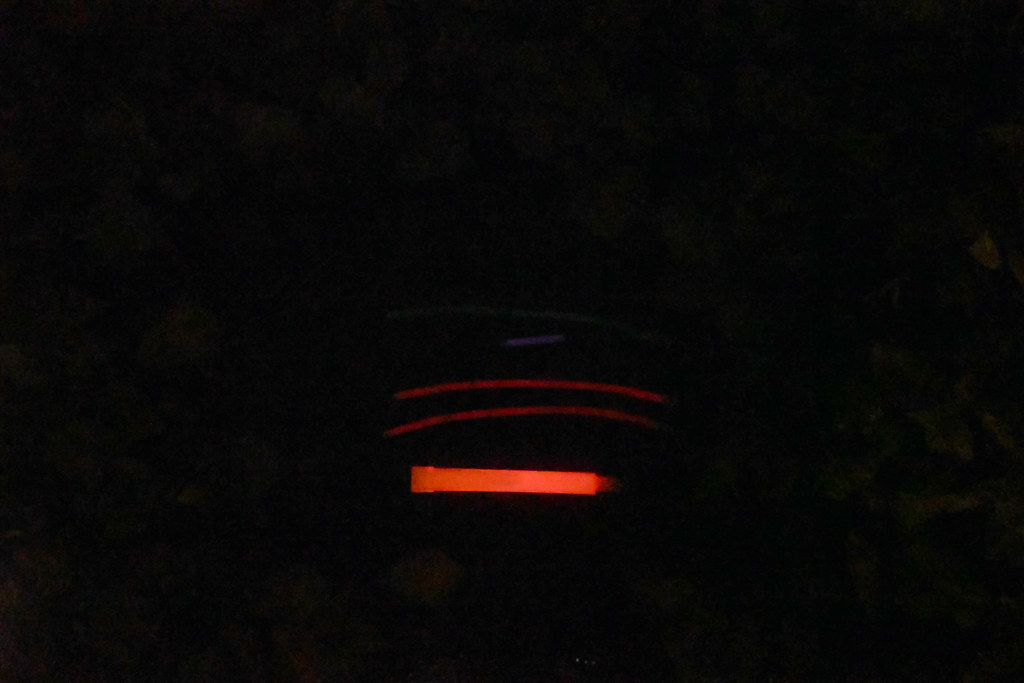
Anyway, here's a video demonstrating the relative brightness, and how minis turn into dots at even a few feet range, while the "bracelets" are visibly lines at some distance.
Next, I have to find (I swear I have one) or make a demo of 5, 30, and 8/12 hour brightness Cyalumes. It's neat!
Extended Life
Before the next bit, I guess worth mentioning the context of why I know so much about weird lightsticks. Because we do training not war, and over time it's become hard to get pyro, it's expensive, and many places we use as training ranges can be both flash-flood and red fire hazard. We've experienced range fires with snow on the ground. So, aside from normal team tactics stuff (lane marking, working with your gear at night, setting good patrol bases and OPs...) and being a nerd, finding better solutions and spreading it to our students, we also have found these weird replacements to use as flares, of a sort, for training. Also... we've found some stuff because we use the same ranges over and over again for years.
Q: How long do lightsticks last?
A: Not the time on the label.
It's best to think of them as radioactive. They have a half-life. It is not that straightforward, but the rated time is /close/ to the full-output time. Then, they do not turn off, or drop off rapidly, but persist at a lower and slowly decreasing rate but emitted light is going to be there for long after the rated timeframe.
For how long? Well, it depends. And my observations are either purely anecdotal or from excessively small numbers of samples even when experimental.
Normal 6, 8, 12 hour ones reduce to about 1/2 dimness for say... 50% more time, then slowly degrade further, giving dim marker-level light for another full time period. Say: 12 hours of full bright, 6 hours of dimmer but still "that's a lightstick" and use it to light up an area, and then another 12+ hours at least as bright as a party stick.
The 5 and 30 high intensity ones drop off to normal 8/12 hour lightstick level when they expire their time, then slowly over a several hour period get dimmer yet. I have picked them up after an assault (used as flares) to mark CCPs, set parking for relief vehicles, etc. After it's a flare, it's a good normal lightstick for a long while.
Party sticks placed at dusk to mark campsite safety things are bright enough to see into dawn even in the winter (long nights). Not as bright, but bright enough to not trip over lines in the weird morning light.
Actual minis are usually more dead by morning, to the point that you should consider timeframes when emplacing. Don't set minis out at dusk for a pre-dawn attack, but send someone after midnight to emplace or refresh them, for example. For close range work, like marking where the handmic is in the OP: they work fine into the next night; almost like tritium, they are better after a few hours for this sort of stuff.
Here are the sticks from the video I shared above. Right about 24 hours after breaking the minis and the 6", about 30 hours for the reds, and the yellow party stick (look close, it's above the very dim mini) is from three weeks ago. This is about what they look like to the eye in my normal life, after walking out of the lit house minutes ago:
And adjusted to gather more light, not far from what you'd get more night-acclimated for the reds, but the yellow somehow disappeared, sorry:
The 12 hour red is still casting light; I can read things with it, if held close. The red party sticks are still marginally useful markers in dark conditions at least. The mini is very nearly dead, but is not much brighter than the weeks-old yellow party stick, which pans out. They seem to just keep going and going and going at their dimmest for... ever?
Here, I have thrown the mini into the darkest place I could find in my yard:
It's not that dark out here in the suburb, so a bad test and is clearly visible still. On training range time, we've seen sticks we know are YEARS old that stick out like a sore thumb, a series we can follow as trail markers under NODs when it's moonless under the forest canopy. Years old. How? I don't know. They must be cycling, somehow charging during the day a bit, but... I'll be damned if I understand the chemistry.
Nevertheless this is important to know if you revisit the same territory, use them to mark dangerous items you then clear (like IEDs) or jsut run on the same training range. Pick them up when done if you can. And if lightsticks are important safety markers then don't assume they are all found, and be especially careful about it with processes like color coding or similar (then you ignore that dim red one if blue is the color of the day.
An all too common discussion, or argument, is what is the best category of sighting system for infantry arms. There are a lot of traditionalists who insist iron sights are best, and much discussion of whether red dots, fixed power scopes, or LPVOs (low-power variable optics) are best.
Well, a couple years ago the US Army Research Lab (ARL) actually did a very relevant study. Their plan was to determine if a universal zero or soldier zero is best. Now while that's not the focus of what we care about, to avoid you being distracted we'll talk about that briefly. Soldier zero is what you do with your gun, or what the US generally does; the individual zeroes his gun for himself. A Universal zero means the armorer zeroes the rifle for you. For example, the reason the G3 has a weird sight tool is to make sure soldiers in the field can't mess with it, as only armorers are allowed to zero the gun. On purpose.
But to get there, they did a test of how well each of those zeroes worked... on four different sighting systems!
That means we incidentally got data on how well each of those sighting platforms work, on the same gun, with the same soldiers shooting, under the same conditions. For those not 1000% familiar, I'll summarize which is which:
Standard M4 Carbine Iron Sight — The MATECH flip up BUIS (Back Up Iron Sight), but basically an aperture or peep sight, with a range dial.
Vortex Razor 1-6x — I guess because 3 years ago, off the shelf, not type classified scope. The defining characteristic of the LPVO is the bottom end is 1x, and ideally is like not looking through a scope at all. Also usually with an illuminated reticle, bright enough to be seen during the day so it sorta operates like a red dot sight at 1x. Reticle is not specified but will likely have a way to hold off for range.
M68 Reflex Sight — The Aimpoint Comp M... something. They use "M68" for all of the several generations. I assume nothing based on the photo, but all Aimpoints are pretty bog standard RDS, or Red Dot Sights. If you think the holographic EoTech is very different, it's not. All Reflex/Collimator/Holographic/RedDot sights are about the same. No reticle, just a dot. No ranging ability.
M150 Advanced Combat Optical Gunsight — A normal 4x ACOG, the newer one (replacing the TA01) is this, the TA31 (Army) or PVQ-31 (USMC). Fixed power, illuminated via fiber optics and tritium and no diopter adjustment for the individual shooter's eyes. Has a BDC reticle to adjust for different ranges if fired off the expected platform (M4) with the proper ammo, and everything is as planned.
And the results? Lots and lots of stats. Let's not worry about them, and don't agonize over the number of participants. I do some research for a living, and for the type of study, and the results and analytical methods chosen it is fine. These are valid results.
Biggest takeaway: Irons are terrible. As we've known for individual programs back to the late 1940s, anything is better than irons. Even at 100 m on a range, notably worse results. As I was once told, "Falklands experience confirmed that at 400–500m, even when you had the ballistics to threaten the foe, iron sights and fear were a bad mix for getting hits (we didn’t do badly - after all we won - but we did take a hard look at what worked well and what could go better)..."
As range increases, the next most obvious thing occurs, in that the red dot begins to suffer. This is likely the direct result of no magnification, so the shooter's eyes are doing a lot of work.
The M4 and ACOG are optimized for about 300 m distance, and it shows here, with a notable dropoff in accuracy, nearly to RDS levels, at 400 m.
The LPVO is the best as range increases. Likely because of the small additional magnification, but there may be something else such as dialing vs holding ranges. It's unclear, and would be good to observe people shooting such a test.
One last note is that they did not test a magnifier behind the M68. That should have provided similar results to the LPVO, but it would be good to try out.
Using this Info For Swift Fox and other CWG events:
Due to the limited range of the simulation systems we cap all magnified optics at 4x. But even then, we've seen the reduced-range version of these results as everyone brings their own guns and so we see a broad range of sighting systems. This sort of thing (or classes, or so on) is one reason that these results are not at all confusing and in fact the conventional wisdom.
Even at closer ranges, there's a notable benefit to optics. While a red dot sight would seem to be enough, the research also was on a flat range, but we've seen magnification be helpful at least as close as 50 m, to see through brush, or pick out camouflaged individuals moving slowly under partial concealment.
For Swift Fox 23 we'll be back on the ground, in the woods of Oklahoma. Try out your weapons systems and skills April 21-23. Sign up today.
We really tried to squeeze in an in person event in the fall of this year, but the schedule is tight. Fall is always busy and this year, everyone else is doing the same thing. Instead of fighting the schedules and having low turnout as well as causing agony to everyone in the community, we're going to try to help.
CWG has cancelled Least Weasel 21, our Force-on-Force event for the fall, and instead has two events planned, that we hope you'll all attend. The first is set up specifically to allow you to plan and prepare for your other upcoming Fall tactical activities.
Fall '21 Fieldcraft
Keep your skills sharp or specifically prepare for force-on-force, re-enactment, training, or other field events by attending our short fieldcraft weekend. Starts mid day Saturday, and ends as early as the next morning, giving you 18 hours of tactical movement, bivouacking, communications, communication, observation, and concealment. As long as you can be comfortable, safe, and effective, bring and wear whatever you want, no uniform requirements. Sunday will be day of AARs, a chance to fix your gear and get familiarity with other CWG equipment and procedures.
Our regular springtime force-on-force event will take place at the normal time, place, and duration, come hell or high water. And we mean it. We fight day and night, in all weather. And this time with a new twist, with insurgents to confound the battlefield with different tactics, as they do. Come prepared for anything.
April, 2022 in Wyandotte, Oklahoma
Watch for announcements of dates and when we accept signups.