Central War Gaming Blog

Central War Gaming Blog


Sunday, January 31, 2016

The Combat Medic at CWG Events

Every week we're another step closer to hitting the field. Supplies are arriving, squad rosters have been created and team Combat Medics assigned. Casualty cards are having the finishing touches put on them. It is time to talk about what our Combat Medics will do, why they do it, and how this impacts the effectiveness of your squad.


For those who have not had a chance to read the medic and respawn rules, you should start with those.

New rules? Why new rules? 

Once you read them you may ask "Why?" Why add complexity? Why fix what isn't broken? Is there some value missing from normal medic rules that is added under this new system?

Every time new or different medic rules are created for an airsoft game, this is the question. Here at CWG we absolutely recognize this issue, and haven't written our medic rules just to be different, but because feel they better match the style of the event, and can improve the game.

We considered the best practices from:

  • Airsoft, paintball and blank-fire re-enactors
  • Military training exercises
  • Tactical medicine training
  • Real world treatment of combat casualties 

We balanced what was possible, what was safe and inexpensive, and considered the effects of each of a number of proposed solutions on game play.

Because we know from experience that needless complexity kills events. While some requirements and details help make it more realistic and immersive, too much can kill the fun. Making every player understand all the details is annoying when every event has its own methods and procedures.

In the end, we were able to develop a set of medic rules that are reasonably realistic, add some complexity but also make it simpler for most players

The role of the Combat Medic

How to do this—how to strike the balance between challenging and fun—was surprisingly straightforward.

You have probably played with a guy who has a rocket launcher. If he's any good at actually killing vehicles or bunkers with it, then it probably almost defines him in game. He's the rocket guy because he knows his weapon, the range, how gassed up it is, and is always thinking how he can maintain and employ it (or when not to). You haven't got one yourself because it looks like it takes a lot of effort.

The same is true of a Combat Medic. Anyone assigned to be a Combat Medic becomes that as their specialty. Note the word "combat" in their title is key; they will also carry a rifle, and fight with the team, but the speciality is medic, so they will spend time not just carrying a pack with a red cross on it, but thinking about resupply, considering where to go to both fight and to care for squad injuries when the shooting starts.

When the first screams for "medic" arrive, the Combat Medic is the only one who can go and patch up your team, so they can keep fighting. But they also have to decide if it's more important to stay in the fight or be a medic; if there's an ongoing fight, it's often best to finish that first or there may be more casualties, including the medic. When many are injured, you have to decide who is more worth saving, or if that guy already shot in a previous battle is worth your dwindling supplies.


The role of everyone who is not a Combat Medic

This also means the medic rules are much easier for everyone else. If you are a rifleman, fire team leader, machine gunner or anyone else when hit you:
  • Yell "Hit!"
  • Lay down
  • Get out your red rag
Just like usual, and then you wait for the medic. Okay, there's a fourth item; you also have to note the time as we use the typical five minute timeout before you are dead.

Our medic rules actually result in less to do or remember than most events, because only the Combat Medic can fix your injuries. If your buddy gets hit, there's nothing to do but scream "Medic!" or maybe help drag him to safety.

Supplies for the Combat Medic

While the medic rules discuss multiple ways to treat wounds, and refer to carrying around a whole bag of supplies, it's really not that complex. Medics only really need three types of medical supplies:
  • Cravats (fabric slings)
  • Elastic bandages (like ACE™ bandages)
  • Aluminum splints (like SAM® Splints) 
CWG provides these supplies, and the medic and squad leader work to decide how many to carry, and how best to carry them. While the medic is the only one who can use them (and has to carry a medic bag with casualty cards, markers and so on), supplies are supplies so can be carried by anyone in the squad.

Limited supplies, and a limited ability to carry them all, may require triage from the medic. Triage is just the process of determining priority of treatments and rationing of care and supplies, based on the severity of their condition and the overall situation.

The various supplies are needed because different wounds get different treatments. Each Combat Medic will be issued a set of casualty cards. The rates of different parts of the body hit are based on actual studies of wounding in our most recent wars, and each card tells the medic how to treat it. Some get a slung arm, some get a splinted knee, and so on.

Of course, some injuries cause immediate death. The cards are random, so you never know the results until the medic gets to you. Part of the evaluation the medic performs when he arrives involves what the hit player is wearing. Helmets and body armor in CWG events provide actual protection; a hit to the torso may be a minor wound with armor, but kill when not wearing armor.

Once wounded and treated, you are free to keep fighting, as much as you can. A splinted knee makes it hard to walk, but you can shoot just fine. And if you get hit again? We start over, the medic evaluates you and patches up whatever part got hit this time. There are ways to deal with a wound to the same part of the body, and we'll cover all that in subsequent articles.

What medic rules mean to your event

Leaders will have to work with medics to manage supplies. Leaders will have to accomplish the mission while dealing with wounded players who have reduced mobility. They will need to plan for functional casualty evacuation. If members of his team can't walk, they need to be carried out or brought to a truck.

Medics will have to know how to treat the various wounds, and do so quickly, effectively, and while staying in the fight. They will have to decide when to treat a single serious wound or to save supplies for multiple minor wounds. Sometimes people will die because of this. Medics will have to make timely requests to their Squad Leader for supplies so it doesn't interfere with the mission.

Soldiers will have to balance comfort and armor. They will have to assess the risk of receiving a potentially serious wound versus making bold moves to defeat the enemy, knowing that wounded slow down their team. Soldiers will also need to keep track of their buddies so they can find and/or carry them to safety.

Leaving your buddies to die, thereby saving you a hassle is not a good plan. Wounded troops can talk after being "saved" and can function within the limits of their bandages/slings. Having an arm in a sling does not put you out of the fight at all. Eyeballs are a potent weapon to use against the enemy!
Dead soldiers take their knowledge with them to the grave, and can not use it during the remainder of the game.


In the coming weeks we'll be posting much more detail on how to be a medic, and will review each possible medic card as well as how to use the supplies to properly treat each wound.


Tuesday, January 26, 2016

The Splints are Here!

Especially if you are one who has been assigned to be a Combat Medic at Swift Fox 16, you might wonder how serious we are about the medic kit, and what the supplies will be like.

Well the answer is: Moderately serious, and here's some of them.


That's a case of rolled aluminum splints. Knockoff SAM® splints. When you open a Casualty Card, and it says to splint, you will pull one of these, and some elastic bandages (on the way) and cravats out of your medic pack, and use them to secure joints and limbs. 


We cannot really simulate bleeding injuries, or penetrating torso injuries with chest seals and airways, without risking actually injuring you guys, so we've gone for an emphasis on mobility, effectiveness and structural injuries. 

And we make you treat those injuries with realistic equipment, such as actual aluminum splints. 

You will only be issued so many supplies like this. Managing their use (triage), and going and getting the used ones back from the CCP to put them back in service (logistics), is a key part of being a Combat Medic at a CWG event. 

Sunday, January 24, 2016

A Look at the Kitoy Armed Forces Modernization Plan (KAFMP)

Anybody paying attention to the status of forces in the region would notice that the Kitoy Armed Forces appear to be modernizing in a rather haphazard way. The most obvious signs are the weapons platforms. Since the decision was made to switch from the 7.62x51mm round to the 5.56x45mm, it has shown the inability of the Replublic of Kitoy to make these changes to their entire force consistently, and in a short time.

While all front line individual rifles are now chambered the same and are all variants of the US made Armalite Rifle, that is as far as the uniformity seems to go. Within units of the KAF you can see times when almost every soldier has a different variant of AR. This is due to the way the Kitoy Ministry of Defense has to buy items, in smaller batches as their funding allows. In the long run this is not just a nightmare for logistics, but costs a lot more as the government cannot negotiate better prices.

So when the Request for Proposal came out for a new Individual Load Bearing Vest many of us were shocked. The ILBV program called for a modular vest to be produced under a single contract to supply the whole of the KAF. This was a great sign that the Republic of Kitoy was behind a full modernization of their armed forces. However, it seems that was not truly reality. Since the release of the draft RFP in February of 2013, little progress has been made.

Some companies began to produce some prototypes based on the draft requirements. And while the ILBV program has not made much progress these various prototypes can be seen worn by members of the KAF, sInce members of the KAF are allowed to wear private purchase gear. This is not to say that the ILBV program will not ever move forward, hopefully it will, but at least the KAF can modernize from within the ranks. Below is the information released by the KMoD almost exactly two years ago.

Solicitation Number: KFA-1AQ4-W15QKN14R0065
Notice Type: Presolicitation
Date of Release: 08 February 2013
Organization: Federal
Agency: Kitoy Armed Forces
Sponsoring Agency: Army of the Republic of Kitoy
Responsible Agency: Program Office - Soldier Systems, Office 17B, Block 9, Esmeth Tower, Cyaiga, Cyaiga 1209-A27, KITOY


Synopsis:
This is a DRAFT Request for Proposal (RFP) KFA-1A-Q4 for the Individual Load Bearing Vest . This announcement is issued for planning purposes only and constitutes a request for exchange of information pursuant to Kitoy Federal Acquisition Standards section 18.23 and KFAS_50.232. The purpose of exchanging information is to both improve the understanding of Government requirements by industry, and improve Government knowledge of industry capabilities. Offerors are directed to NOT submit proposals at this time.

The Government has determined a need to find the best ILBV that provides the best value to the Government. The ILBV will provide the service-members with a highly reliable load bearing system throughout the range of military operations and environments. The ILBV will also possess the ability to utilize current and future accessories through the use of the Pouch Attachment Ladder System (PALS). The ILBV will replace current load bearing system(s) and leverage commercial technology advancements.

This ILBV DRAFT RFP, for the Individual Load Bearing Vest , is issued under a Full and Open Competition environment, subject to KFAS part 50. The Government intends to award up to three Indefinite Delivery, Indefinite Quantity (IDIQ) type contracts, with a final down select to be made to a single contractor for their design. All resulting delivery orders will be firm fixed price. The Government will select for award(s) the proposal(s) which represent the Best Value to the Government.

Potential Offerors are invited to participate in a question and answer forum with ILBV personnel, focusing on the ILBV DRAFT RFP. This Q&A forum will provide an opportunity for potential Offerors to ask questions prior to the release of a final solicitation. Offerors shall submit questions electronically no later than April 14, 2013. It is anticipated that questions submitted will be posted on the Kitoy Federal Acquisitions website along with corresponding answers.

Note: No information exchanged with industry will be considered in the evaluation process. Offerors are directed not to submit proposals at this time.

This is a special notice only and is for planning purposes only. THIS IS NOT A FINAL SOLICITATION AND DOES NOT OBLIGATE THE GOVERNMENT TO ISSUE A FINAL SOLICITATION.


Excerpt from Draft Statement of Work

Section A
A.1 Background
The Kitoy Ministry of Defense initiated the Kitoy Armed Forces Modernization Plan (KAFMP) in February of 2012. The plan calls for the incremental modernization of the Kitoy Armed Forces' equipment. The Individual Load Bearing Vest (ILBV) is an important component in this modernization plan.

A.2 Objectives
The ILBV objectives are:
1) Replace the various load bearing systems in use in the Kitoy Armed Forces (KAF) today. 2) Provide a standardized load bearing platform for all of the KAF

Section B
B.1 English Language Requirements
B.1.1 All deliverable documents will be in the English Language.
B.1.2. An English language speaking person shall be provided during in-plant visits, inspections, reviews, audits, and other similar activities to facilitate communications and ensure mutual understanding.

B.2 Specifications
B.2.1 Material Specifications
B.2.1.1 The Contractor shall produce the vest in a materials durable enough to withstand extended use in the field.
B.2.1.2 The vest shall fasten close with two side fastening quick release buckles.
B.2.1.3 The material used for the buckles shall remain its properties in tempertaures as low as -25°C
B.2.1.4 The material used for the buckles shall remain its properties in tempertaures as high as 160°C
B.2.1.5 The material used for the buckles shall have a tensile breaking point of not less than 32 MPa
B.2.1.6 The material used for the buckles shall have a impact resistance of not less than average of 63.7 J/m
B.2.1.7 The material used for the body of the vest and webbing shall not burn, nor transmit a flame front across its surface, at a rate of more than 102 mm per minute
B.2.1.8 The webbing and material shall have a color retention not less than No. 2 on the KNTA Geometric Gray Scale
B.2.1.9 The median breaking strength of the color test samples shall be at least 60% of the median breaking strength of specimens of the same type of webbing and material not colr fast tested.
B.2.1.10 The materials used for the body of the vest and webbing shall be subjected successively to the procedures prescribed in KNTA Test Method 30-81, Fungicides, Evaluation of Textiles; Mildew and Rot Resistance of Textiles, Section 1B3 -- Soil Burial Leaching, Section 1C2 -- Volatilization, and Section 1B3 -- Soil Burial Test.
B.2.1.11 The median breaking strength of the micro-organism exposed samples shall be at least 85% of the median breaking strength of specimens of the same type of belt webbing without any exposure to microorganisms
B.2.1.12 All materials used in the construction of the vest shall be subjected successfully to the salt spray test, according to KNTA B117-73, for a period not to exceed 25 hours, consisting
of 24 hours, +0, -0.25 hour of salt spray exposure followed by 1 hour, +0, -0.1 hour of drying.

B.2.2 Design specifications
B.2.2.1 The vest shall open along the front center line.
B.2.2.2 The vest shall be covered with Pouch Attachment Ladder System (PALS) webbing on its external surfaces.
B.2.2.3 The Contractor shall produce magazine pouches of the same material and coloration as the vest
B.2.2.4 The Contractor shall use hook and loop for flap closures on magazine pouches that have closure flaps
B.2.2.5 The Contractor shall produce magazine pouches with both open tops as well as with closure flaps
B.2.2.6 The Contractor shall produce magazine pouches that hold the magazines in a vertical position
B.2.2.7 The Contractor shall produce magazine pouches that hold the magazines with the long side of the magazine parallel to the wearer's body
B.2.2.8 The Contractor shall produce magazine pouches that will hold a single magazine without a closure flap measuring 152mm tall x 76mm wide x 25mm deep
B.2.2.9 The Contractor shall produce magazine pouches that will hold two magazines side by side without a closure flap measuring 152mm tall x 152mm wide x 25mm deep
B.2.2.10 The Contractor shall produce magazine pouches that will hold a single magazine with a closure flap measuring 216mm tall x 76mm wide x 25mm deep
B.2.2.11 The Contractor shall produce magazine pouches that will hold two magazines side by side with a closure flap measuring 216mm tall x 152mm wide x 25mm deep
B.2.2.12 The Contractor shall produce machine gun ammunition pouches measuring 203mm tall x 165mm wide x 89mm deep
B.2.2.13 The Contractor shall produce pouches that will securly hold a one liter canteen measuring 216mm tall x 127mm wide x 76mm deep
B.2.2.14 The Contractor shall produce pouches for general purpose use measuring 280mm tall x 140mm wide x 50mm deep
B.2.2.15 The Contractor shall produce pouches for general purpose use measuring 127mm tall x 77mm wide x 50mm deep
B.2.2. The Contractor shall produce additional pouches for attachment to the vest based on direction of the Government. These additional pouches will be funded separately under Engineering Change Proposal vehicles.

The full specification can be seen at https://acquisition.arok.mod.kir/asfi/solicitation_view.cfm?psolicitationnbr=1AQ4W15QKN14R0065


Sunday, January 10, 2016

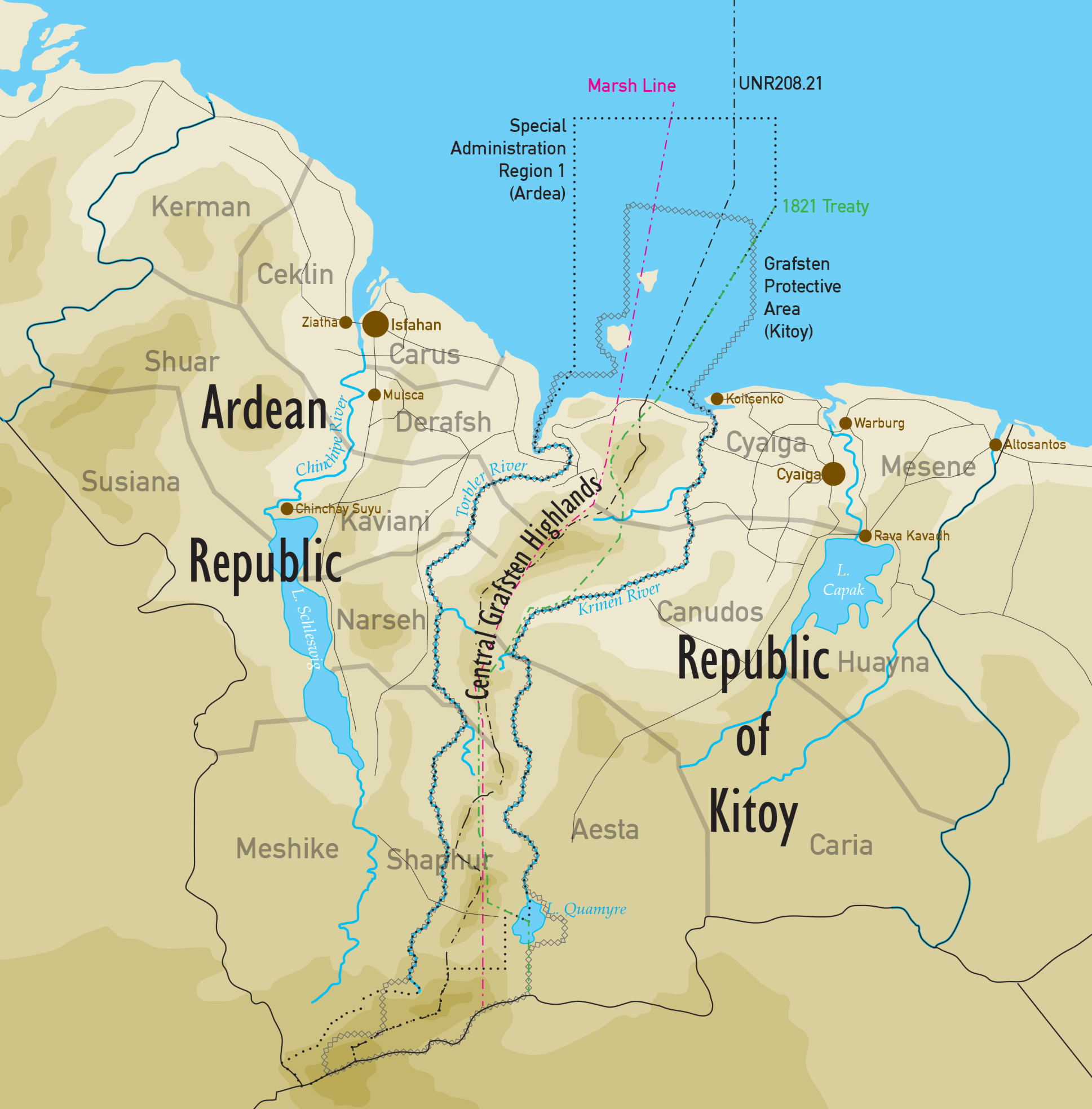
The Central Grafsten Highlands

The countries of Ardea and Kitoy are essentially at peace. They have no existential threats, their armies are relatively small, and have sometimes been characterized as "ceremonial" by their detractors. Throughout most of the country, they are involved with border protection, maritime security, and spend most of their resources preventing the smuggling of drugs, weapons and interdicting human trafficking.

But there is also one longstanding, low-intensity conflict that occupies both armies. The border between the two countries is highly disputed, and in a very difficult piece of terrain. 

The Central Grafsten Highlands are a mountainous region running broadly north/south, and extended far to the south of both Ardea and Kitoy. Within most of the Ardea/Kitoy border, the region is geographically isolated between the Torbler and Krinen Rivers, with tall mountains occupying essentially the entire space in between.


Much water runs off these mountains, and causes the rivers to be both fairly fast and for their level to change. There are few bridges, and ferries generally cannot operate on them due to the current and slope. Within the Highlands, there are few major roads, and those are rarely paved. Few bridges and tunnels mean very circuitous routes are often required to get anywhere. Many of the more appealingly flat and fertile plains flood and are not easily traversable for several months in the spring and fall, so even there, access and maneuver is difficult. 

This traditionally limited the use of the region to a fairly small number of hunters, trappers, fishermen and herders. As national boundaries became solidified in the late 18th century, this was a natural boundary and the difficult terrain meant arbitrary lines on maps were never really surveyed. Even in law, the border is vague, and there are conflicting interpretations. 

A traditional subsistence hunter in a wetland in the marshes north-east of Lake Quamyre as photographed in 1880. — National Center for Indigenous Heritage (Kitoy)

There has never been a year-round road route over the mountains between the two countries, and rail never developed in the area, traditionally limiting contact between the two nations to the extreme coasts, and sea routes.

At the turn of the 19th century, indigenous clay miners discovered valuable salt deposits in the Highlands, and within a decade there were dozens of salt operations across the Highlands. Additional minerals were discovered, and foreign companies (especially British and French ones) invested in mineral exploitation, and transport. 

These operations often disregarded the national boundaries, and around 1830, the then Kingdom of Ardea was the first to use soldiers to gather taxes, repossess mines and forcibly eject foreigners from their territory.

With the money at stake, this led to legal actions — some of which are still ongoing — and continued use of troops, by both sides. By 1850 there were several skirmishes a year due to poor maps, limited roads, and the different interpretations of the border areas. 
Engraving of a Kitoy artillery battery of the 52nd Ciagan Guards Militia moving through a Highlands village in Canudos province, 1858. — National Highlands History Museum (Kitoy)

The conflict died down during and after the First World War, and the inter-war period saw little attention paid to the region as the value of the traditional commodities (lumber, clay, salt, turpentine, and so on) became too low to make it worth the effort. 

After the Second World War, American oil and gas companies used new technologies and new understandings of geology, and began to acquire mineral rights to the region. Estimate of the reserves vary widely, but it is now valuable again, and with the long-standing disputes there is little hope of any resolution soon. A handful of offshore wells are operating, but the two Navies and Coast Guards spend much time facing off over the disputed border in the ocean. 

Military operations have ebbed and flowed, but since the 1960s have been quite regular, and are largely concerned with obtaining generalized control over the area, and supporting international legal actions. No drilling or mining company will commit to operations with this unrest, and since the 1970s both Ardea and Kitoy have banned permanent settlements. There are numerous abandoned villages, and the roads and bridges built between 1930 and 1955 are generally in poor condition. 

Military operations are low intensity out of necessity. The poor terrain conditions mean only light vehicles and infantry can operate in the region. Helicopters would work, but neither nation has the overall military budget to have sufficient helicopters to change the tide of the effort. The conflict has also never met global political needs; there is no drug harvesting, no terrorists and no communists so foreign military assistance is essentially non-existent. 
An Ardean supply convoy during a halt in the fall of 2004. — Carus Weekly Journal

Within these constraints, military operations have a relatively free hand. The lack of population, or of current economic activity means the militaries of both Ardea and Kitoy have considered the Central Graften Highlands to be their exclusive domain, and have — at least within their countries — legal authority to carry out actions as though in a foreign country, with minimal oversight by civil courts, police or any local governments. 

The Kitoi took this to a horrifying extreme, and for almost a decade had fairly free reign to pursue enemy agents. By the late 1980s the size of these units and their scope of control had expanded to almost a third of the country. A campaign of imprisonment, often torture, and a few political assassinations on Kitoi soil — all in pursuit of a largely illusory terrorist organization — very nearly led to civil war. A new government elected in 1994 largely stopped military operations.

In 1997 a Truth and Reconciliation Commission began it's work, and resulted in changes to the Kitoi National Police, Justice Administration, and the Army. Entire units were disbanded, and only a carefully handled Truth and Reconciliation Commission prevented further unrest and a threat of jailing over a thousand soldiers and policemen. 

Ardea had similar issues, though with far fewer consequences to the overall nation. Their worst abuses were in the treatment of workers and villagers in the Highlands, and especially during the 1970s when a handful of narco-terrorists from nearby countries led the army to believe civil unrest was around the corner. In 2001 the government committed to paying over 10,000 surviving relatives (and their decedents) of the 1978 evacuation a small monthly stipend for the next century, but other cases continue to wind their way through the courts and Congress. 


An Ardean patrol sweeps a long-depopulated village in Narseh in 2010. Due to destruction of records, there is no good count of the number of forcibly abandoned villages across the Highlands. — Ardean Republican Army Press Service

In both countries, units operating in the Highlands are conventional Army units, are not permanently based their, and have significant civil oversight. While the arrangements vary in detail, in both Kitoy and Ardea, the regional governments have some say in operations, the police services carry out investigations for all shootings, and the Army cannot detain enemy soldiers or civilians found, but must hand them over to civil authorities within a short timeframe. 

These moderating influences to military action, the value of minerals in the land, almost two centuries of historical conflict, and the endless legal battles mean there is no end in sight for fighting in the Highlands. 

Thursday, December 31, 2015

H&K G3 Rifles

Ardea issues 7.62 rifles almost universally to their soldiers and other forces. Using an FN FAL airsoft rifle has already been covered, but now let's talk about the second most common .30 caliber rifle, the G3.


Like a lot of mid-century technology, the basic technology behind the G3 started during World War II. Mauser continued developing the roller lock as used in earlier guns, like the MG42 for use in an individual rifle. It was never fielded, and the Nazis who worked on it went to France after the war to develop it for a rifle competition that never quite happened. They then moved to CETME (an arms development institute) in Spain where they got the opportunity to develop it more.
The wartime G-45

The story is very, very long and complex, but after the US forced the 7.62 cartridge down NATO's throat, the rest of the world still didn't resist pointing and laughing at the hilariously outdated M14. The Germans wanted the FAL like everyone did, and issued a bunch of Belgian-made guns as the G1. The German government wanted to get a license to make them in Germany but the Belgians turned them down. There are two versions of that story: The head of FN "rudely insulted" the German delegation, or that the Germans were insensitive clods in the negotiations with a factory they had a decade earlier been running with slave labor, blown up when they left, and sent rockets to blow up more after that.

Spanish sailors still occasionally use CETME model C rifles. In the back is a similarly old model Z62 SMG. 

After some more looking around, some rifle competitions and improvements by HK and DWM, the G3 was adopted. It should be noted that the first fielded German guns were different from what we're used to, in several ways. They were gray parkerized things, with wooden stocks and different sights, basically like the CETME model A. They evolved into the shiny black drum sighted gun we're used to, and all the early ones were arsenal refurbished, so German Army issue guns are all the same.

Eventually, Germany got equipped enough that HK sought export licenses, and by the late 1960s were competing with the FN FAL. Others who bought the gun bought it after the Germans had updated to the current A3/A4 spec so they all look the same, and mostly have plastic stocks.

The G3 was also turned into a whole series of rifles. The MP5 is a very small G3, and a 5.56 mm version (the HK33, or HK93 in civilian guise) was also made. There is an airsoft HK33 so don't be confused by that one when searching out ones to buy.

The G3 Today

Most 7.62 armies that used the G3 have switched to the 5.56 cartridge now. G3s are either relegated to second-line use, or are only used for specialty roles such as marksmen, or mountain troops that need the extra range. Naturally, they are also used by police and paramilitary forces.

The Swedes are a good example of current use. Their AK4 rifles were all arsenal refinished, and as part of that the sights were cut off, a rail was welded on, and they all wear a special Aimpoint. Every Home Guard (basically, everyone in Sweden) has one of these in a locked box under their bed or in the back of their closet, so keep that in mind if you try to invade them.

The Germany Army, despite going to G36s for their rifle, and automatic rifle, still use G3s for their designated marksman weapons. As you can see, in pretty unmodified format, with no rails or funny add-ons, it works fine for them.


The Ardeans are one of those countries that had enough battlefield success with the 7.62 rifles, and insufficient budget to switch over, so keeps them in front line use.

G3 Rifle Variants

Many G3 rifle variants are made but we only allow full size G3A3 or G3A4 rifles, with full or telescoping stocks, and the slightly shorter G3K (which is not produced but can be easily modified to). This does not include the HK51, MC51, SAS, or other SMG-sized versions. Those are not real, factory produced or issued guns. We also don't allow any side-folding stocks, M16 telefolders, etc. Only commonly-issued, real world variants are allowed.

Top to bottom, G3A3 (fixed stock), G3A4 (telescoping or retracting stock), G3K. Nothing shorter than the G3K was ever made by any arms factory or issued to anyone. 

The G3/SG-1, G3/SG-3, MSG-90, and PSG-1 variant sniper/marksman weapons are also not allowed. Note that many manufacturers and retailers list their guns as "sniper" rifles or call G3A3s "SG-1" variants. This is rarely true, The PSG-1 has special stocks, a bulky tripod instead of a bipod and a weird scope. The SG-1 has a prominent set trigger, and so on.

See, that's a tedious sniper rifle, not an infantry rifle. Pistol grips and stocks from this, while they just clip on, should not be on your G3 rifle, either. 

HK also made machine guns and automatic rifles based on the G3. The HK11 and 13 are magazine fed automatic rifles, so are not allowed. However, the HK 21 and 23 belt-fed machine guns are allowed, if you can find one of the few, or wish to make one, but only as machine guns. They cannot double up as your individual rifle.
Heavy, interchangeable barrels (for extended firing), belt fed, sights calibrated to 1200 yards for area denial, heavy bipod, and stocks for reverse grip to control it. These are normally actually used from the MG42 tripods, when not on the assault. Machine gun, not a rifle. 

This long thread has zillions of photos of the various parts of an HK21, so will be good to guide you, or to discourage you when you see how many parts are different from the rifle. You cannot fake a lot of this with PVC, but probably have to buy some real gun parts. Expensive ones. The rear sight is available, but is $400, the belt box, when available is $500! 

Under-Barrel Grenade Launchers

While not super-common outside the German Army, and no airsoft versions exist, HK made a grenade launcher for the G3 rifle, the HK79.

Norway only started replacing their G3s in 2010, so still used them heavily in Afghanistan, and still issue some. This guy has an HK79 under his dusty gun.

But that doesn't mean you cannot have a grenade launcher. Many countries just went ahead and put M203s under their G3s. Remember, these are guns from before the era of the RIS. M203s easily clamp straight onto any barrel, which is good since we do not allow rails. No army routinely issued rails on their G3s, and there's not a really good one. Certainly not one that can handle the recoil of a grenade launcher.

The Turks formally use an M203 setup on their G3 rifles. They have a domestically produced variant of the M203 they call the T-4, and use a handguard similar to the older USGI open-bottom one. 

HK also made a ladder-style grenade sight, calibrated from 50-350 m, as seen on the Turkish rifle above. This folds flat, but can be elevated for use, and is quite modular, clamping onto the rear optical sight mounting position. this does remove the ability to add optical sights, so is not always used. 

No, I've never, ever seen one for sale, but it wouldn't be too hard to fake one by cutting up a cheap bolt-on sight base and adding a suitable-looking ladder sight

Airsoft 3G Rifles

Airsoft G3s tend to be nominally stronger than other airsoft guns. They are harder to break than the typical AR-15 and Kalashnikovs that most players are familiar with. Obviously, they are still airsoft guns, so are not as indestructible as real guns.

They are also modular to a great extent, and the basic components are held together by pins, just like the real G3. This makes them much easier to disassemble than many other airsoft guns. If you are planning to learn how to work on airsoft gearboxes this would be a very good start.

Modifying your Airsoft G3

Real G3 and HK91 stocks and other accessories are readily available. Some, such as proper scope mounts are very expensive, but some such as surplus stocks are very cheap.

Real stocks and foregrips don't quite fit out of the box, but can be modified to fit airsoft versions. It requires careful removal of some material inside of the stocks, but is not complicated and does not require specialized equipment.


Here are a few examples of real steel parts and accessories:
The semi-auto commercial model of the G3 is called the HK-91. Numerous CETME model C rifles were also imported as parts kits to the US, and converted to semi-auto, civilian legal guns. These are both basically identical to the issue rifle as far as parts, accessories, mag pouches and the like go, so if you search on gun part dealers, or eBay it may be worth checking these model numbers as well.

A few things fit several or all models, but not all accessories. Slings are universal, bipods fit the 33/93 and the G3/91 (but not the MP5), but scope mounts fit all three.

Metal bodies are important if you want to attach the clamp-on HK scope mounts, or use them with heavy scopes such as night vision devices. Plastic bodies are more often out of spec, and will crack under the force of the mount clamping on.

Night sights often have to mounted very high, so you need a cheekrest or to simply have an odd pose. This is a good reason to invest in a real claw mount, so you can remove the night sight during the day. Also, another M203 under a G3. 

The G3A3 and A4 are not quite as long as the FAL, with barrels (on the real guns) around 18" long. The G3K is their "Para" equivalent, though it is never called that, with a shorter 12.5" barrel. It is most often seen in use by armored vehicle crews, or others who need the space.

While no airsoft G3Ks exist, they aren't that hard to make. You just have to remove the exposed barrel, so the flash hider and grenade ring come straight out of the end of the handguard retaining ring, and then reduce the length of the handguards. Of course, that's impossible, but G3K stocks are simply HK33 stocks, which you can find in airsoft guise or simply get a real steel one.

You can then either cut and re-attach, or simply buy the CA HK33 and combine with your G3 to make a convincing-looking hybrid.

A custom "G3K" airsoft gun Mac Schlosser made by merging a CA HK33 front end with a G3A3. 

Officially, a G3K should have a telescoping stock (why else would you bother having the short front) but since they are still modular, a full stock can be fitted if you really need the room for a battery. As long as it's a normal G3 stock, not a sniper stock, sidefolder, etc. we don't mind. 

As long as you have a good reason, such as a night vision sight, we'll even let cheek rest stocks from the G3/SG1 and MSG-90 fly. 


Getting an Airsoft G3 Today 

Naturally, Tokyo Marui was the first to make a G3 rifle. These were all plastic, but improved over time, and were (along with the MP5) one of the earlier guns for which aftermarket metal receivers were available.

The TM pattern has been followed by all those who cloned it, so most parts, and all magazines are interchangeable. That's convenient, unlike airsoft FALs, as you can safely borrow from anyone with a G3.

  • Tokyo Marui: Made the original airsoft G3s long ago, and is still sometimes in production and available. 
  • Classic Army: Off and on production over several years. Plentiful enough to find used options from the community.  CA offered a correct telescoping stock version (G3A4), as well as the fixed stock G3A3. All appear to have metal "bodies" (receivers). Currently there are no CA G3 available new US stores, but might be soon, as they are being released in Europe in the coming months. Uses TM magazines without issue, as well as real HK accessories.
  • JG: As is often the case, offers an inexpensive, functional option which is still in production. It's even readily available in the US currently. Many JG guns served for years at Eastwind, without a single issue in stock form. Correct specs, allow use of TM magazines, and real HK claw mounts for optics.

Some examples of CWG-acceptable G3 rifles currently for sale are:

You can't buy it, but this is the CA G3A4. Pretty...


Wednesday, December 30, 2015

IMPORTANT NOTICE: Change of Dates for Swift Fox 16

In 2016, Easter falls unusually early, in late March instead of April. We're not the only ones who were surprised by this and scheduled poorly. It turns out the field where we're playing in Oklahoma was reserved (long ago and by a recurring event) for Easter weekend also (thinking it was in April), so we can't have the dates.

So, we have to move Operation Swift Fox 16 to the next weekend. The dates are now Friday 1 April through Sunday 3 April. Start times, locations, and everything else about the event is unchanged.

We hope this actually makes your plans simpler, and and that you can now bring some other friends and team-mates who couldn't do the Easter weekend.

However, we are aware some of you might have conflicts on the new date, or you have to plan your work schedule far enough ahead this causes issues. If you do have problems, please tell us about it, and we'll do whatever we can to fix this for you.

Monday, December 21, 2015

Field Craft weekend Jan 2-3 2016

Allan Swayze will be hosting a weekend of classic East Wind style field craft training exercises tailored to the specific training needs of Swift Fox attendees the weekend after next.

Show up bright and early next Saturday, January 2nd at the Roby Lake trailhead of Paddy Creek Wilderness for an overnight event. Best part: It's free!

Everyone must bring the following items, and remember you are light infantry, so everything you carry has to be packed in your ruck:

  • Rucksack 
  • Sleeping gear
  • Sleeping pad
  • Shelter half, plasch or bivy bag
  • Rain gear
  • Properly fitted boots
  • Properly fitted uniform
  • compass
  • Red filtered flashlight
  • Mess kit and silverware
  • Capacity to carry a minimum of 2 liters of water on your person
  • Boo boo kit (Bandaids, ibuprofen, antacids, allergy meds, whatever)
  • Spare pair of socks
  • Clothing appropriate to the weather
  • Pen and paper (suggest waterproof pad and a pencil)


For more details, directions, to say you are going, ask questions and coordinate travel, see the thread on the Operation: East Wind forum


© 2015-2016 Central War Gaming | Contact Us | Facebook | Twitter